What is Laparoscopic Cholecystectomy?
It is the removal of the gallbladder. The procedure is done through several small punctures, rather than a single large incision. The laparoscope is a long, thin tube with an end camera. While the surgeon is playing the image projected on this camera on the TV, operating it. The gallbladder is taken into the abdomen through a small hole.

Cholecystectomy
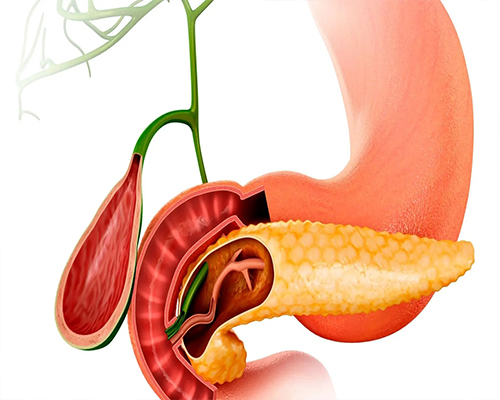
Gall bladder
The gallbladder is a pear-shaped organ located in the lower right part of the liver.
Its main job is to collect and concentrate bile, a digestive fluid produced by the liver. Bile is secreted after eating to aid digestion and travels through narrow and tubular channels (bile ducts) to the small intestine. Removal of the gallbladder does not cause digestive disorders in most people.
What Causes Gallbladder Problems?
Gallbladder problems are usually caused by the presence of gallstones. Gallstones are small, hard masses of bile salts and cholesterol in the gallbladder or duct.
It is not known why it develops in some people.
There is no known method to prevent gallstones.
These stones can block the flow of bile out of the gallbladder, causing the gallbladder to swell, causing abdominal pain, vomiting, indigestion, and occasionally fever.
If the gallstone blocks the main bile duct, jaundice may occur.
How to Identify and Treat These Problems?
Ultrasound is often used to find gallstones.
In some more complex situations, other x-ray tests may be preferred to evaluate gallbladder disease.
Gallstones do not go away on their own. Some can be eliminated temporarily with medications or a diet to reduce fat intake.
The success rate of this treatment is low .
Surgical removal of the gallbladder is the safest and most time-efficient way to treat gallbladder disease.
What are the Advantages of Performing the Surgery Laparoscopically?
Instead of a 10-15 cm incision, only four small openings are created in the abdomen.
Generally, patients have less pain after surgery.
Compared to patients who have had open gallbladder surgery, they recover more quickly.
Most patients are discharged within a day and can return to their normal activities more quickly.