What are abdominal hernias?
Abdominal hernia is the protrusion of the hard membranes called muscles and fascia that make up the abdominal wall from the abdominal cavity from a weak point. Usually, as a result of weakening of the muscles in the abdominal wall, an organ or tissue emerges from this weak spot in the abdominal cavity and forms a hernia. Hernias may occur spontaneously, due to trauma, and as a result of incisions in previously operated areas. It can be examined in three groups as inguinal hernia, umbilical hernia, and surgical incision hernia.
What is an inguinal hernia?
It is a type of hernia that occurs with increased intra-abdominal pressure on the right, left or both sides of the inguinal region. Since the opening called the internal ring, located in the anterior wall of the abdomen, through which the spermatic cord in men and the ligamentum rotundum, which is one of the ligaments holding the uterus in place in women, passes, is weaker than the abdominal wall, hernia mostly occurs in this region. Excessive straining as a result of chronic constipation, prostate enlargement in men, heavy lifting, straining to urinate, persistent cough due to asthma and chronic bronchitis are the most common causes of inguinal hernia, which causes indirect inguinal hernia and swelling under the skin of a part of the intestine. A direct inguinal hernia occurs in the inner part of this weak area, in the upper middle region of the abdomen. Hernia formation here also occurs with an increase in intra-abdominal pressure based on similar reasons. In boys, it usually occurs in the abdominal cavity as a result of the testes, which have completed their development in the abdomen, descending and returning to their normal position, and if the area is large, a part of the intestines slides into this region and creates a hernia. However, if there is no space that is too large for the intestines to fit, a hernia may occur as a result of fluid accumulation. The risk of hernia is usually seen in newborn boys. Premature babies are at greater risk. Having a family history of hernia and being overweight are risk factors as it increases intra-abdominal pressure. In people who have developed a hernia before, there is a possibility of developing a hernia on the other side of the groin.
What is an umbilical hernia?
There are 3 different veins in the umbilical cord, that is, the umbilical cord, which provides the nutrition of the baby in the mother’s womb. Umbilical hernia occurs when the umbilical region, which is strengthened by binding and closing by the surrounding muscles, remains weak after birth. When it occurs in infancy, the hernia may swell and become visible during crying. In a few years, a hernia in babies can close on its own, but if it does not close, surgical intervention is required. An umbilical hernia may occur in individuals who have reached the childhood, in cases where the umbilicus is not fully closed or is excessively forced. Fat tissue covering the upper part of the intestines on the belly button and a part of the intestine cause hernia formation. In adults, about 8% of those who apply with a hernia complaint is an umbilical hernia. It is more likely to be seen in overweight women who have given birth, men with a history of prostate, overweight or sudden weight loss, heavy lifting, and chronic cough. Even if there is no visible swelling or deformity, in some cases the hernia can be felt with the finger. Surgery is the only treatment option for an umbilical hernia in adults, and it is easier to operate when the hernia is in its infancy and small. The operation can be performed either closed or open, depending on the patient’s condition.
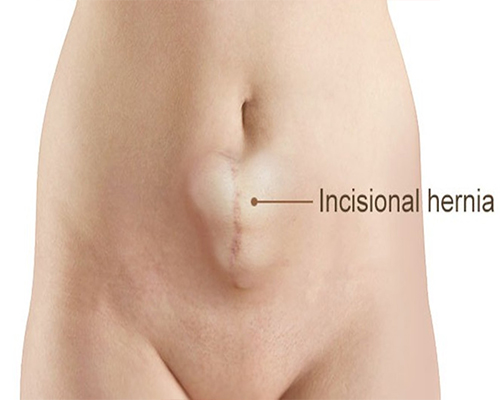
What is a surgical incision hernia?
It is a type of hernia that occurs in the incision areas of previous abdominal surgeries. It may occur as a result of insufficient tissue healing after surgery and weakening of the tissues after years. Incisional hernias that can develop in more than one area; It can also be observed with swelling in the area of the scar when standing, coughing or straining. However, since this type of hernia can grow rapidly, it should not be expected if such a situation is noticed. It is treated with open or closed surgery.
What is a herniated disc?
Lumbar disc herniation, also known as herniated disc, develops between the vertebrae on the spine. The gel-like connective tissue, also known as the disc, which connects the vertebrae and acts as a cushion by providing flexibility, begins to lose its function with the loss of water due to aging. As a result, it leaves its natural position and forms a herniated disc. Lumbar hernia mostly occurs in the last two discs in the lumbar region and is characterized by low back pain, pain and numbness in the legs, and weakness in the feet. In some cases, lumbar hernias are treated non-surgically and the treatment is rearranged according to the result. These treatment methods are usually rest, anti-inflammatory and pain medications, exercise, physical therapy, steroid injection. All of the drugs should be used as prescribed and if there is no improvement, the physician should be consulted again. Lumbar hernias, in which surgical treatment is also applied, are performed with partial discectomy or discectomy methods. Local, spinal or general anesthesia
Operations with the herniated disc are made through a small incision on the herniated disc. In some cases, pressure may occur in the nerve roots leading to the leg area, loss of strength may occur, and surgery may be required urgently.